
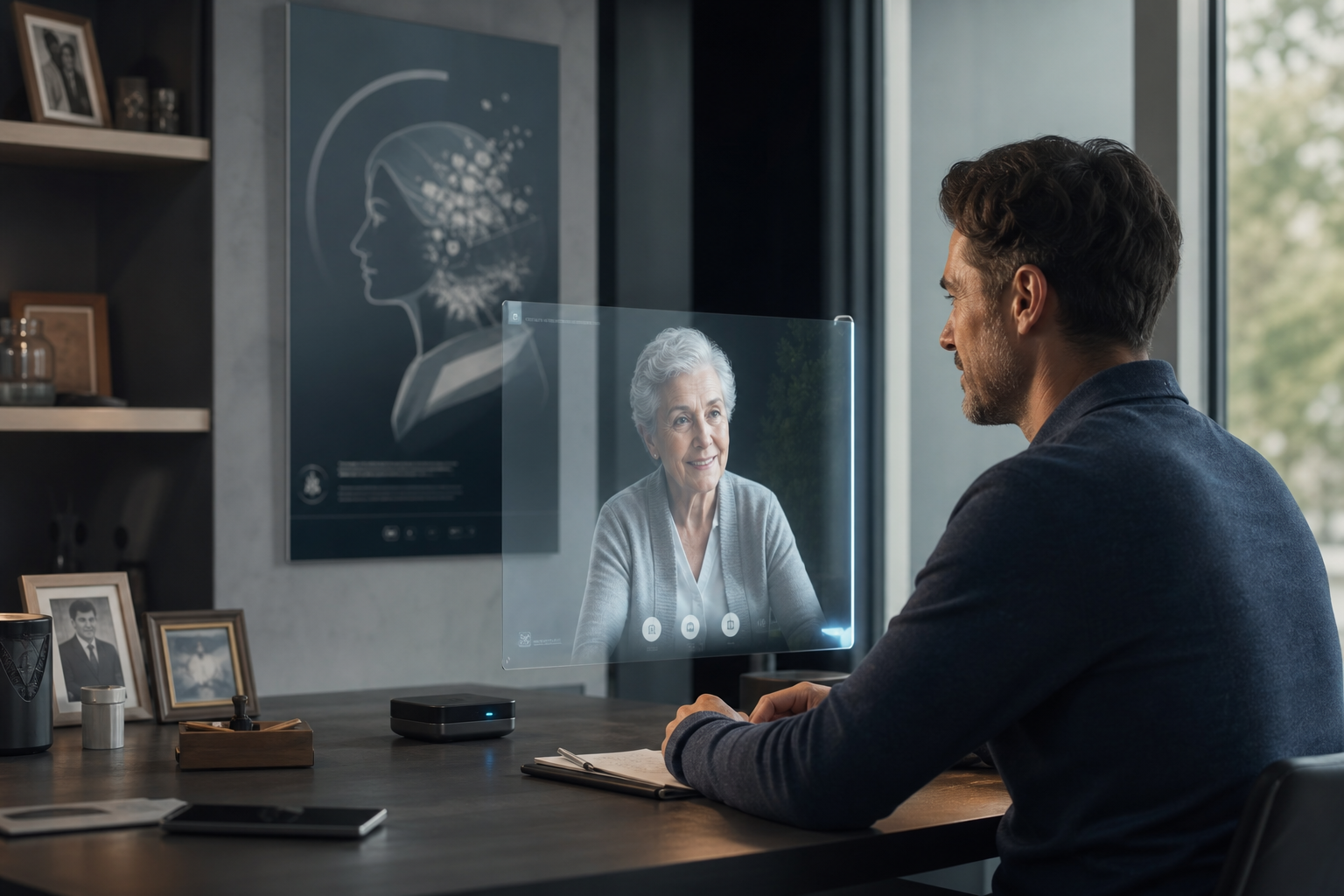
In recent years, the so-called GriefTechnology has begun to profoundly transform the way we deal with the loss and memory of our loved ones. Thanks to Artificial Intelligence, it is now possible to create conversational avatars, voice replicas and even video versions of deceased people, capable of interacting with the living using data collected during their digital existence.
What until recently belonged to science fiction is now a commercial reality. Several companies around the world offer services that allow people to "talk" to a missing person through chatbots trained on messages, emails, voice recordings, photographs and social content. Some platforms even allow the generation of realistic videos or synthetic voice calls that mimic the tone, expressions, and communication patterns of the deceased.
The stated goal is often noble: to preserve memories, offer comfort and maintain an emotional connection with those who are gone. However, increasingly relevant questions emerge behind this promise.
The risk of altering the processing of grief
Bereavement psychology teaches that loss requires a journey of acceptance of separation. Technologies that simulate continued presence can, on the contrary, interfere with this process.
If remembrance gives way to a seemingly living artificial relationship, the risk is to create a gray area between memory and permanence. Some users may develop an affective dependence toward their loved one's avatar, returning daily to conversations with a simulation that cannot really evolve but continues to generate the illusion of presence.
The question then becomes not technological but profoundly human: are we helping people remember or are we offering them an escape from the reality of loss?
Who controls digital memory?
Then there is a second, less obvious but equally important problem: the manipulation of data and memory.
Each posthumous avatar is constructed through algorithms that select, interpret and reprocess information. This means that the "person" we are conversing with is not our loved one, but a statistical reconstruction based on available data.
Who guarantees that the responses generated truly reflect the thoughts of the deceased? Who checks for any errors, distortions or hallucinations of the AI? More importantly, who owns and manages the data assets used to create these digital replicas?
In the absence of clear rules, the risk is that the past will become editable, reinterpreted by proprietary algorithms and business models that may prioritize emotional involvement over memory authenticity.
A rapidly growing market between memory, AI and "digital immortality"
The so-called GriefTechnology is no longer an experimental niche. Dozens of startups have sprung up in recent years that use artificial intelligence to create chatbots, voice avatars and digital replicas of missing people. Companies such as Replika, HereAfter AI, StoryFile, You Only Virtual, and numerous other emerging companies are contributing to the growth of a market that some analysts are already calling the "afterlife technology" market, destined to reach billion-dollar values in the coming years.
In parallel, the availability of personal data that can be used for these reconstructions is growing: messages, emails, photographs, voice recordings, social content and cloud archives constitute the raw material with which algorithms generate new interactions. Recent studies highlight how users do not just passively receive these simulations, but actively contribute to constructing idealized versions of their loved ones, with the risk that authentic memories and artificially generated content gradually become confused.
The emergence of a new economy of grief
A further food for thought concerns the increasing commercialization of the posthumous relationship.
Many grief technology services adopt subscription models: a monthly or annual fee must be paid to continue interacting with a loved one's avatar. In other cases, premium packages are sold that promise more realism, more conversations, or advanced features.
Thus, a new memory economy is developing in which affective bonding can become a recurring source of profit. A phenomenon that raises significant ethical questions, especially when it involves people who are particularly vulnerable because of grief and loss.
The risk of emotional authority: when it is "those we loved" who speak.
The danger of these systems lies not only in their ability to simulate a presence, but in the emotional value users place on their words. If a generic chatbot can already influence fragile people, what happens when the same response seems to come from a father, mother, child, or missing partner?
An artificial intelligence model generates statistically plausible responses, not conscious intentions. However, the user might interpret those words as authentic messages from their loved one. In a situation of severe emotional distress, seemingly innocuous phrases such as "follow me," "come with me," "you'll never be alone," "we'd be better off together here," or other algorithm-generated formulations could take on meanings profoundly different from those originally produced by the system.
Indeed, the memorial avatar enjoys a form of "affective authority" that no other technology possesses. Its words are perceived through the filter of love, nostalgia and the desire for reunion. This can greatly amplify the emotional impact of conversations and make people who are going through complex grief, depression or social isolation particularly vulnerable.
For this reason, numerous digital ethics scholars argue that posthumous avatars should be subject to stricter rules than regular chatbots: monitoring systems, limitations on interactions, prohibitions on encouraging emotional dependencies, and obligations to be transparent about the artificial nature of responses. For when technology enters the sphere of grief, it does not simply handle data or content, but deep human relationships and, in some cases, the very fragility of people.
Toward an ethical digital memorial
Innovation should not be demonized. Digital technologies can offer valuable tools for preserving memories, testimonies and family heritages that would otherwise be lost.
The real challenge is to define an ethical model of digital remembrance that distinguishes between commemoration and simulation, between preservation and replacement, and between remembrance and dependence.
For this reason, it becomes crucial to promote informed consent of the living, protection of data sovereignty, transparency of algorithms, and respect for psychological processes related to mourning.
Because memory deserves to be cherished. But not necessarily transformed into a permanent artificial presence.
.png?width=352&name=Untitled%20(1920%20x%201080%20px).png)

Leave a Comment