
For years we have lived inside an extremely fragile illusion: that of being able to build an ever larger, more intense and meaningful digital life, without having to truly redefine the concept of privacy.
We have transferred online intimate conversations, personal relationships, work, memories, fears, desires, political opinions, fragments of our most authentic identity. We have progressively inhabited digital ecosystems as if they were natural extensions of our existence, without realizing that those places were not really ours. They were not our homes, but "rented" premises and therefore liable to change, however reprehensible, by their owners.
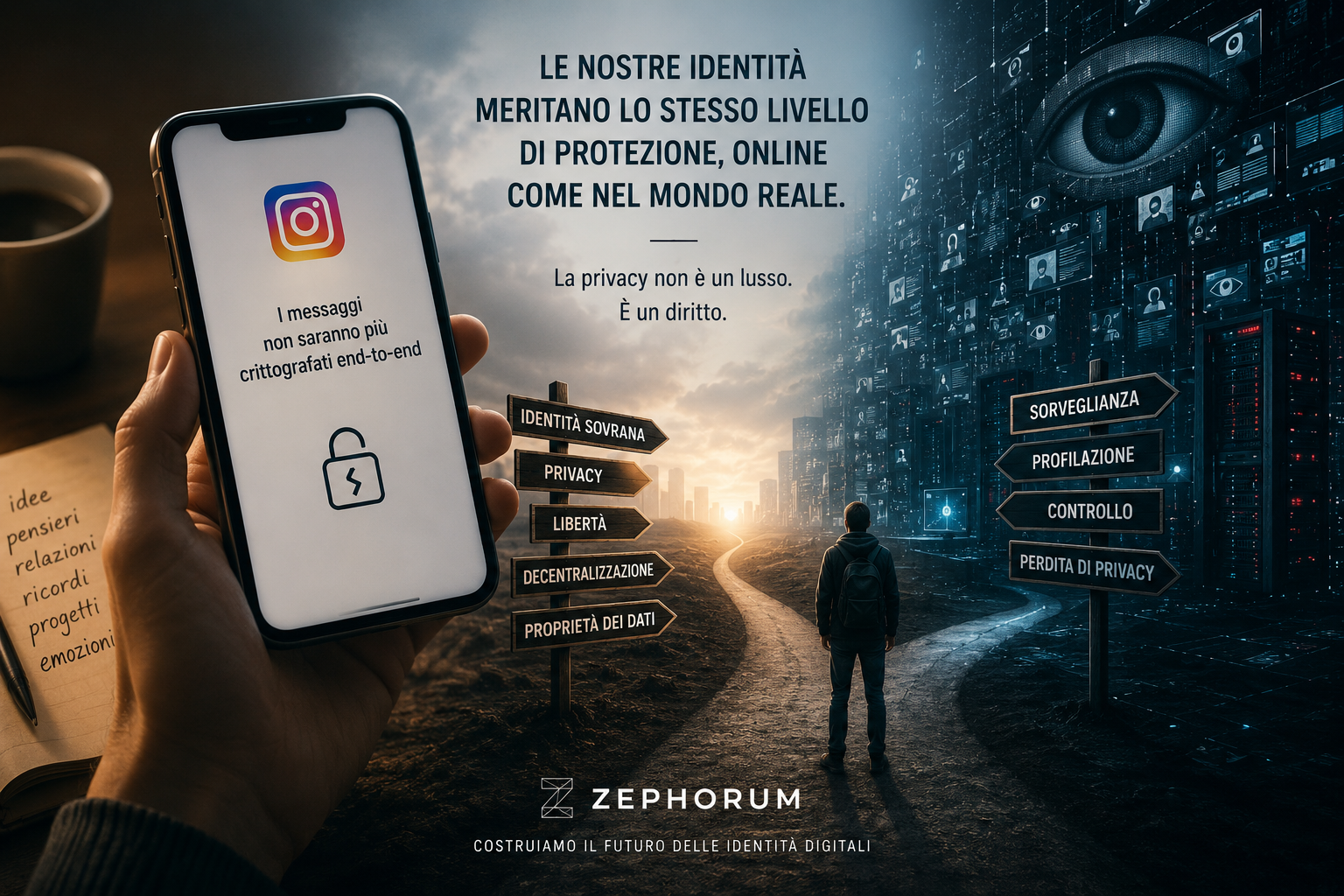
The possible end of encrypted messages on mainstream social platforms, and particularly on Instagram, does not simply represent a change in technological policies, but is the symbol of the final closing of an era when the Internet still promised inviolable and protected personal spaces.
For a long time, encryption was perceived as a technical detail, something meant for cybersecurity experts or digital activists. In reality, encryption represented one of the last invisible boundaries between the individual and the infrastructural power of platforms. It was an implicit declaration that, despite everything, some conversations could still belong exclusively to the people experiencing them.
Today, that boundary seems to be dissolving slowly, almost soundlessly. Andperhaps that is the most disturbing aspect: the normalization of the surrender of privacy.
Over the past decade we have witnessed a profound cultural transformation: digital surveillance has become systemic, but more importantly, it has become familiar to us. Users have learned to live with constant profiling, with algorithms that interpret behavior, emotions and habits, with platforms capable of knowing preferences and vulnerabilities better than people themselves. We have adapted to the idea that every online interaction leaves a permanent trace, that every behavior can be archived, correlated, analyzed. That our digital identity is simultaneously a tool of expression for us and an inexhaustible source of data for unknown third parties.
Yet we continue to underestimate a central fact: virtual identities are real identities. The distinction between physical life and digital life has now dissolved.
Today, online reputation can determine professional opportunities, social relationships, economic access and public credibility. Our accounts hold personal memories, emotional connections, private conversations, emotional archives and deep psychological fragments. In many cases, a person's digital presence holdsmore social value than their physical presence . And instead we protect these identities with infinitely lower standards than we would demand in the concrete world.
In the real world, no one would accept living in a completely transparent home. No one would consider it normal to have private conversations potentially accessible by third parties. No one would tolerate the idea that one's behaviors are constantly monitored to build predictive profiles of one's personality.
Online all this has gradually been assimilated as the inevitable price of access to digital services.
The possible erosion of encryption on Instagram thus opens up a much broader question than just technical security. It raises a philosophical and political question about the very future of human experience in the digital.
Those who own digital infrastructure thus progressively. also own the ability to influence memory, reputation, relationships, and social behavior. And with the evolution of artificial intelligence this dynamic may become even more profound.
In the future, it will not be necessary to explicitly "spy" on people to understand them. Algorithms will be able to infer intentions, emotional frailties, orientations, and decisions simply by analyzing language patterns, response times, relational networks, and digital microbehaviors. The privacy of the future will be about what systems will be able to infer about us even without our explicit consent. And this is where one of the most important challenges of the coming years emerges.
We will probably see the emergence of a new collective awareness. More and more people will begin to realize that digital identity protection is not a technological luxury, but a civic necessity.
Decentralized ecosystems, platforms built around data ownership, autonomous identities and truly distributed cryptographic infrastructures could grow. A new generation of digital environments could emerge in which users are no longer simply "guests" of a platform, but owners of their online presence.
Will the real evolution of the Internet finally be about trust?
Digital platforms are becoming permanent existential environments. Places where we work, build relationships, develop reputations, and define our public and private identities. And if virtual identities are now a concrete extension of the human being, then they should receive the same basic protections as physical identities: security, ownership, confidentiality, continuity and dignity.
The end of encrypted messages on Instagram might appear, at first glance, as a simple technological upgrade. But perhaps it will be remembered in the future as something much greater: the historic moment when the world realized that digital privacy was one of the fundamental pillars of individual freedom in the 21st century.


Leave a Comment